

From play to national policy: How Lively Minds scaled from a promising innovation to reach 1.1 million children.
Jun 11, 2026
Today on International Day of Play, we celebrate the power of play to transform children's lives. But for play to fulfil its potential and ensure it impacts children's lives, learning and future livelihoods, it must reach children at scale. The story of Global Innovation Fund investee Lively Minds, published in our Scaling Insights series, shows how catalytic funding, evidence, and government ownership can help to make that happen.
In rural Ghana, a simple but troubling reality helped shape the origins of an innovation.
Research involving more than 2,500 parents found that only 13% had engaged in any form of play or stimulating activity with their child in the previous three days. Yet decades of evidence show that play and responsive caregiving during the early years are among the most powerful drivers of children's cognitive, social and emotional development.
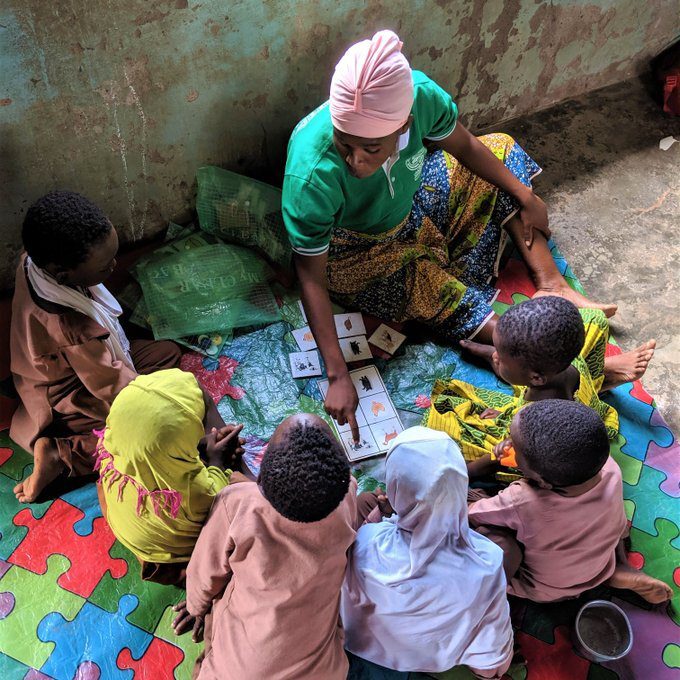
Founded in 2008, Lively Minds set out to address this challenge. Its model is deceptively simple: train groups of mothers to run educational play schemes in government kindergarten schools, while also equipping parents with the knowledge and confidence to support learning at home.
The programme helps children develop early numeracy, literacy, problem-solving and social skills through structured play, while recognising a powerful truth often overlooked in education systems: parents are children's first and most important teachers.
Today, that idea is on track to reach more than 1.1 million children every year across Ghana. But this outcome was never guaranteed. Like many promising innovations, Lively Minds faced the challenge of moving from a successful model to a scalable solution embedded within public systems.
Building the evidence for scale
The Global Innovation Fund first supported Lively Minds in 2016, providing grant funding to support the set up and running of play schemes in partnership with the Ghana Education Service (GES) in six districts.
Further funding was awarded to the Institute of Fiscal Studies to conduct a Randomised Control Trial, in partnership with Innovations for Poverty Action involving 80 schools in two districts, covering 2,400 preschool children and 2,400 caregivers. The results were compelling.
The evaluation found that Lively Minds supported significant improvements in children's school readiness, including gains in early numeracy, executive functioning and fine motor skills. Cognitive outcomes improved by 14.2% of a standard deviation on average, with the largest gains seen among children from the poorest households. The programme also improved parenting practices and increased the amount of productive learning time parents spent with their children.
Importantly, the programme achieved these results at low cost, demonstrating not only that the model worked, but that it could potentially work at scale.
For GIF, this is a critical step in the journey from innovation to impact. Strong evidence can help answer a vital question for governments and funders alike: is this solution worth backing for large-scale adoption?
Preparing for scale
Evidence alone rarely leads to scale.
One of the key findings from a recent review of Lively Minds' scale-up journey is the importance of designing for scale from the outset. Successful innovators do not wait for evidence before thinking about scale; they prepare for it.
Recognising this, GIF provided additional venture support funding in 2018 to help Lively Minds develop its scaling strategy and operating model before the trial results were finalised. This meant that when the evidence arrived, the organisation was ready.
When the positive review landed, the Ghana Education Service signed a Memorandum of Understanding with Lively Minds in 2019 to expand the programme across 64 districts in Northern Ghana, with the ambition of eventual nationwide adoption.
With GIF’s support, Lively Minds was ready and prepared to engage government partners, articulate a credible scale pathway, and begin implementation quickly.
Crowding in for growth
Scaling through government systems requires more than evidence and ambition. It requires resources.
In 2020, GIF became the first donor to commit funding to the next phase of expansion, providing a $2.7 million grant to support the initial scale-up. The investment was intentionally catalytic.
By committing early and sharing due diligence with other funders, GIF helped de-risk and build confidence in the programme's scale potential. This contributed to a broader coalition of support, with Lively Minds ultimately mobilising more than $14 million to support expansion across Northern Ghana.
This reflects a core element of GIF's model: using flexible, risk-tolerant capital to unlock much larger flows of funding that innovations need to achieve meaningful scale.
Scaling through systems
Perhaps the most important lesson from the Lively Minds story is that sustainable scale comes through systems, not parallel delivery structures.
Rather than creating a standalone programme, Lively Minds worked closely with the GES to embed the model within existing government systems. Teachers train and supervise parent volunteers, district education teams oversee implementation, and government institutions increasingly lead programme delivery.
This deep government ownership emerged as one of the defining success factors of the scale-up journey. Alongside strong community engagement, iterative adaptation and a relentless focus on learning, it enabled the programme to move beyond pilot status and become part of the education system itself.
Between 2020 and 2025, the programme expanded across 64 districts, reaching around 250,000 children annually. Costs have also fallen significantly as the model has matured, demonstrating the efficiencies that can emerge when programmes scale through public systems.
The next chapter
Following the success of the Northern Ghana scale-up, the Government of Ghana has committed to expanding the programme nationwide. Over the next phase, the model will be rolled out across approximately 15,000 schools, reaching around 1.1 million children every year and an estimated 3.5 million children between 2026 and 2030.
As this happens, Lively Minds' role will continue to evolve. Rather than directly delivering services, the organisation will increasingly focus on providing technical assistance and supporting government implementation — another hallmark of successful systems change.
Their journey shows that transformative outcomes rarely come from a single grant or a single intervention. They emerge through a sequence of investments: generating evidence, preparing for scale, mobilising capital, building partnerships and embedding solutions within systems.